TMT bars are one of the most important materials used in reinforced concrete construction. Although they remain hidden inside concrete, they provide the tensile reinforcement needed to help slabs, beams, columns, foundations and other structural elements perform as designed.
One of the most common questions during construction is: Which TMT bar size should be used?
TMT bars are available in different diameters, and each size has different characteristics and applications. However, choosing a bar should not be based on diameter alone. The required TMT bar size depends on structural design, load requirements, reinforcement detailing and the recommendations of the structural engineer.
In this guide, we explain the Different Sizes of TMT Bars Used in Construction, their common applications and why selecting the right reinforcement matters.
Why Does TMT Bar Size Matter?
The diameter of a TMT bar affects its cross-sectional area and therefore the amount of steel provided in a reinforced concrete member.
Smaller diameter bars serve distribution and secondary reinforcement, and detailing; larger bars provide the required reinforcement area.
However, bigger does not automatically mean better. Using a larger bar than required can increase cost and may create reinforcement detailing, spacing or concrete-placement issues.
The objective is to use the right TMT bar diameter in the right location, according to the structural design.
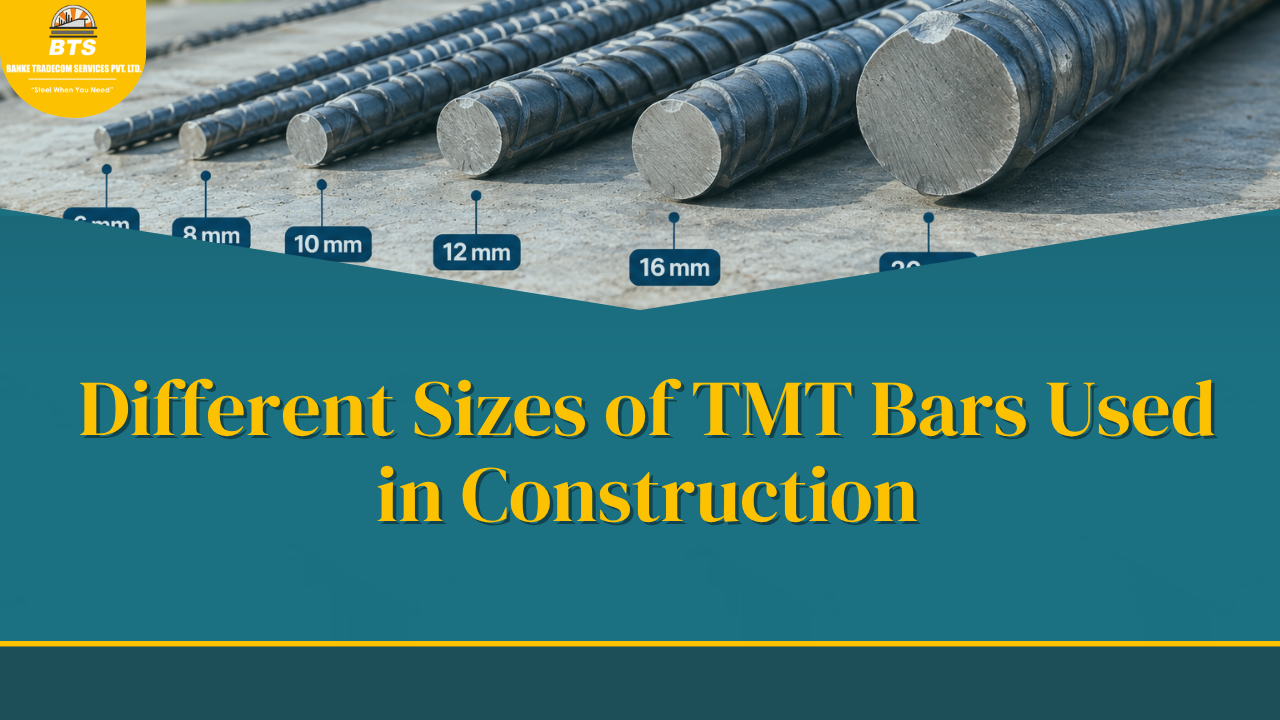
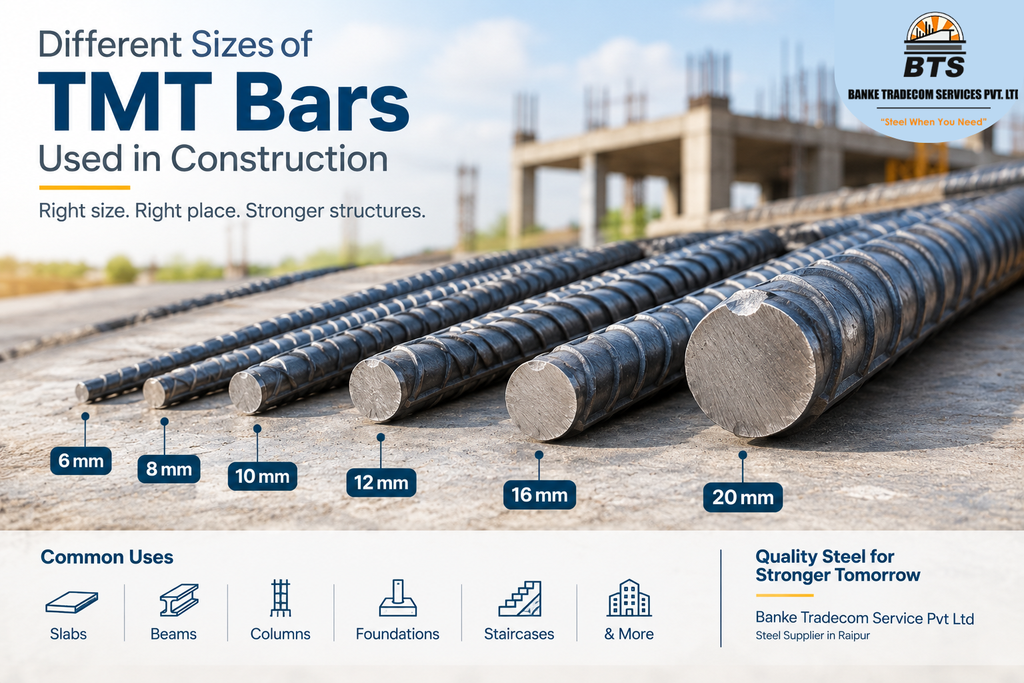
Common TMT Bar Sizes Used in Construction
TMT bars are commonly available in diameters such as:
| TMT Bar Size | Common Applications* |
|---|---|
| 6 mm | Stirrups, ties and certain secondary reinforcement |
| 8 mm | Slab reinforcement, stirrups and detailing |
| 10 mm | Slabs, staircases and secondary structural reinforcement |
| 12 mm | Beams, slabs and columns, depending on design |
| 16 mm | Columns, beams and foundations |
| 20 mm and above | Heavy structural members, foundations and large projects |
*Applications vary according to structural design, reinforcement drawings and project requirements.
We should view the different sizes of TMT bars as a range of reinforcement options rather than fixed rules for particular building components.
6 mm TMT Bars
Contractors select 6 mm TMT bars for several of the smaller reinforcement diameters used in construction.
The bars serve these purposes:
- Stirrups and ties
- Secondary reinforcement
- Certain detailing requirements
- Small construction elements
The exact application depends on the structural drawing and applicable construction standards.
8 mm TMT Bars
Construction teams commonly use 8 mm TMT bars in applications that require smaller reinforcement diameters.
Typical applications may include:
- Slab reinforcement
- Stirrups
- Staircases
- Secondary reinforcement
- Distribution reinforcement
These bars are useful where reinforcement must be bent or placed at closer spacing.
10 mm TMT Bars
Contractors widely use 10 mm TMT bars in residential and commercial construction.
Their relatively manageable diameter makes them suitable for a variety of reinforcement and detailing applications.
Common 10 mm TMT Bar Uses
According to the structural design, engineers may use 10 mm bars in:
- Floor slabs
- Staircases
- Secondary beams
- Lintels
- Distribution reinforcement
Engineers should always confirm the actual requirement from the structural drawings, rather than selecting it solely based on the type of building.
12 mm TMT Bars
12 mm TMT bars offer a greater cross-sectional area than 10 mm bars. Construction teams use them for structural reinforcement.
Depending on design requirements, common applications can include:
- Beams
- Columns
- Slabs
- Plinth beams
- Foundations
The structural design and load conditions determine the quantity and spacing of 12 mm TMT bars.
16 mm TMT Bars
16 mm TMT bars are commonly specified for structural members requiring a larger amount of reinforcement.
Potential applications include:
- Columns
- Beams
- Foundations
- Heavily reinforced structural members
Reinforcement requirements vary significantly between projects, so engineers should derive the diameter, number of bars, and spacing directly from the approved structural drawings.
20 mm and Larger TMT Bars
Engineers use TMT bars of 20 mm diameter and above where larger reinforcement areas are required.
You can find them in applications such as:
- Large foundations
- Heavy structural members
- Infrastructure projects
- High-rise construction
- Bridges and other major structures
The use of larger-diameter TMT bars is based on engineering requirements rather than simply the size of the building.
TMT Bar Size vs TMT Bar Weight
TMT bar diameter also affects its theoretical weight.
A commonly used formula for calculating the theoretical weight of a TMT bar is:
Weight (kg/m) = D² / 162
Where:
D = Diameter of the TMT bar in mm
For example, the approximate theoretical weight of a 10 mm TMT bar is:
10² ÷ 162 = 0.617 kg/m
This calculation is useful when estimating steel quantities, checking material requirements and planning procurement.
Why do we use different sizes of TMT bars together?
A reinforced concrete structure contains different elements, and each element may have different reinforcement requirements.
For example, a slab may require smaller-diameter reinforcement at specified spacing, while columns or heavily loaded beams may require larger reinforcement.
Using an appropriate combination of TMT bar sizes helps achieve the required reinforcement while maintaining practical spacing and proper concrete placement.
Using unnecessarily large bars throughout a project can result in:
- Higher material costs
- Difficult reinforcement detailing
- Reduced flexibility during fabrication
- Spacing and concrete-placement challenges
Therefore, reinforcement should be selected according to engineering design rather than simply choosing the largest available bar.
Common TMT Bar Uses in Construction
The TMT bar uses can vary depending on diameter, grade and structural requirements.
Some common areas where TMT reinforcement is used include:
Slabs
TMT bars are used as reinforcement in RCC slabs to provide tensile capacity and help distribute loads.
Beams
Beams commonly use longitudinal reinforcement along with stirrups. The required bar diameter and quantity depend on the structural design.
Columns
Columns rely on longitudinal reinforcement and ties to provide the required structural capacity and confinement.
Foundations
TMT reinforcement is used in different types of foundations to provide the steel required by the structural design.
Staircases
TMT bars are used to reinforce RCC staircases and support the required loads.
Lintels and Chajjas
Smaller-diameter reinforcement may be specified in lintels, chajjas and similar RCC elements, depending on their design.
Does a Bigger TMT Bar Mean a Stronger Structure?
Not necessarily.
A larger-diameter bar contains more steel per metre, but structural safety depends on much more than bar diameter.
Factors such as:
- Total reinforcement area
- Bar spacing
- Concrete grade
- Structural dimensions
- Load conditions
- Development length
- Anchorage
- Reinforcement detailing
all play an important role.
That is why the correct approach is to follow the structural design and reinforcement schedule rather than replacing specified bars with larger ones without engineering approval.
TMT Bars Quality Matters Along With Size
Selecting the correct diameter is only one part of steel procurement.
The quality and consistency of TMT bars are equally important. Before purchasing, buyers should consider:
- TMT bar grade
- Applicable BIS/IS requirements
- Bar diameter
- Surface condition
- Weight and dimensional consistency
- Manufacturer markings
- Test certificates
- Quantity required
- Delivery schedule
For large construction projects, maintaining consistent steel quality across different batches is particularly important.
Choosing a Reliable Steel Supplier
For construction projects, timely steel availability is just as important as selecting the correct product.
A reliable steel supplier should be able to understand the project requirement, provide the specified TMT bar sizes and grades, maintain consistent supply and coordinate deliveries according to the project schedule.
If you are looking for a steel supplier in Raipur for bulk construction requirements who supply across India, Banke Tradecom Service Pvt Ltd supplies TMT bars and other steel products for construction, infrastructure and industrial applications.
When requesting a quotation, share your required:
- TMT bar diameter
- Grade
- Quantity
- Brand preference, if applicable
- Delivery location
- Expected delivery schedule
Providing complete requirements helps the supplier quote and plan the order more accurately.
Frequently Asked Questions
What are the common TMT bar sizes used in construction?
Common TMT bar diameters include 6 mm, 8 mm, 10 mm, 12 mm, 16 mm, 20 mm and larger sizes. The required diameter depends on the structural design.
Which TMT bar size is commonly used for slabs?
Depending on the structural design, 8 mm, 10 mm and 12 mm TMT bars may be used in slabs. The exact diameter, spacing and quantity should be taken from the reinforcement drawing.
Which TMT bar is used for columns?
Columns may use 12 mm, 16 mm, 20 mm or larger TMT bars, depending on the structural design and load requirements.
Are bigger TMT bars always better?
No. A larger diameter does not automatically make a structure safer. Reinforcement must be selected according to structural calculations, detailing and applicable standards.
What are the main TMT bar uses?
Common TMT bar uses include reinforcement in slabs, beams, columns, foundations, staircases, lintels and other RCC structures.
How is TMT bar weight calculated?
The commonly used theoretical weight formula is:
Weight (kg/m) = D² / 162
where D is the TMT bar diameter in millimetres.
How do I select the right TMT bar size?
The correct TMT bar size should be selected according to the approved structural design and reinforcement schedule. Contractors and buyers should not change the specified diameter without consulting the structural engineer.
Where can I buy TMT bars?
For bulk requirements across India, you can contact a steel supplier in Raipur such as Banke Tradecom Service Pvt Ltd and provide the required grade, diameter, quantity and delivery details.
About us-
At BTS, we stand out as the leading steel supplier all over India. Our decades of experience, in-depth industry knowledge, and customer-first approach make us the preferred choice for all your steel requirements of various brands like SAIL, Tata Steel, JSW, Jindal, JSPL, etc. We proudly deliver PAN India, ensuring timely and reliable supply wherever you are.
📞 Call us now to get a quote!
📍 Location: Raipur (CG)
📞Phone: 07415009930 | 07415009931
✉️Email: sales@banketrade.in | steel@banketrade.in
🌐Website: www.banketrade.in 🌐Blog Site– https://blog.banketrade.in/
Stay Connected with Us on