A building’s strength depends on more than its visible structure. Behind every concrete beam, column and foundation is reinforcement steel that helps the structure withstand tensile forces and everyday loading. But how can buyers know whether the TMT bars they purchase meet the required quality standards? This is where BIS-certified TMT steel bars become important. Certification under the applicable Indian Standard provides a recognized framework for assessing the quality, mechanical properties and conformity of reinforcement steel.
Additionally, homeowners, contractors, engineers and construction companies should understand BIS standards for TMT bars to make informed steel purchasing decisions.
Why Does Structural Safety Depend on TMT Steel Bars?
Concrete is strong under compression but comparatively weak under tension. Reinforcement steel is incorporated into concrete to help resist tensile forces and contribute to the strength and performance of reinforced concrete structures.
TMT bars are widely used in:
- Residential buildings and apartments
- Commercial complexes and offices
- Bridges and flyovers
- Industrial buildings
- Roads and infrastructure projects
- Foundations, beams and columns
The performance of reinforcement depends on several factors, including its grade, mechanical properties, dimensions, bonding characteristics and suitability for the structural design.
Consequently, using steel that does not meet the specified requirements can create quality-control concerns. However, issues like insufficient strength, poor elongation, dimensional variations, or traceability can affect construction and performance.
Therefore, this is why selecting certified TMT steel rebars and checking their supporting documentation matters.
What Is BIS Certification for TMT Steel Bars?
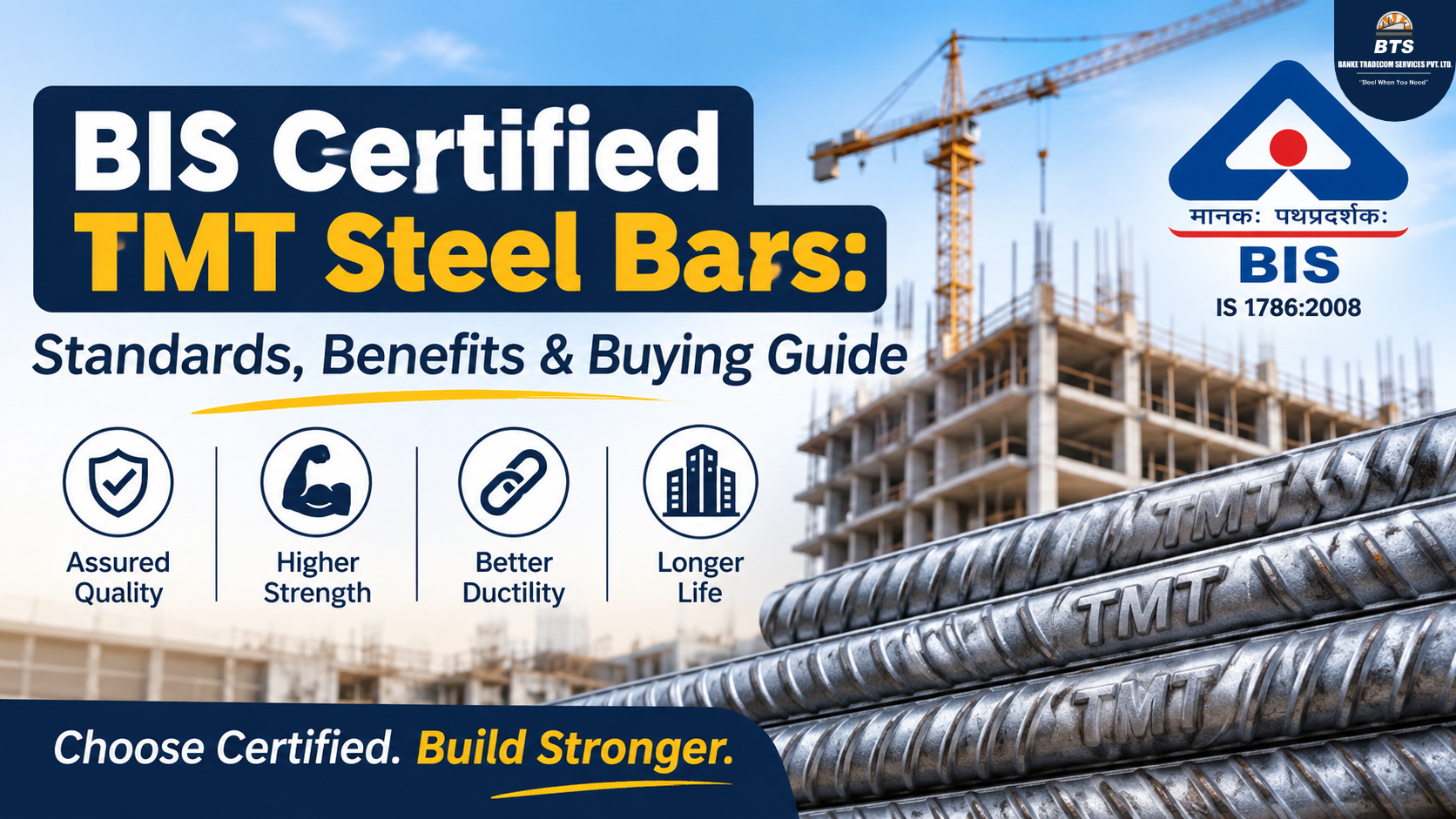
The Bureau of Indian Standards (BIS) is India’s national standards body. It develops Indian Standards and operates product certification schemes for products that fall within their scope.
For reinforcement steel, the relevant standard is:
IS 1786:2008 – High Strength Deformed Steel Bars and Wires for Concrete Reinforcement.
It specifies requirements for different grades of reinforcement steel, including Fe 415, Fe 500, Fe 550 and Fe 600, along with their corresponding D categories.
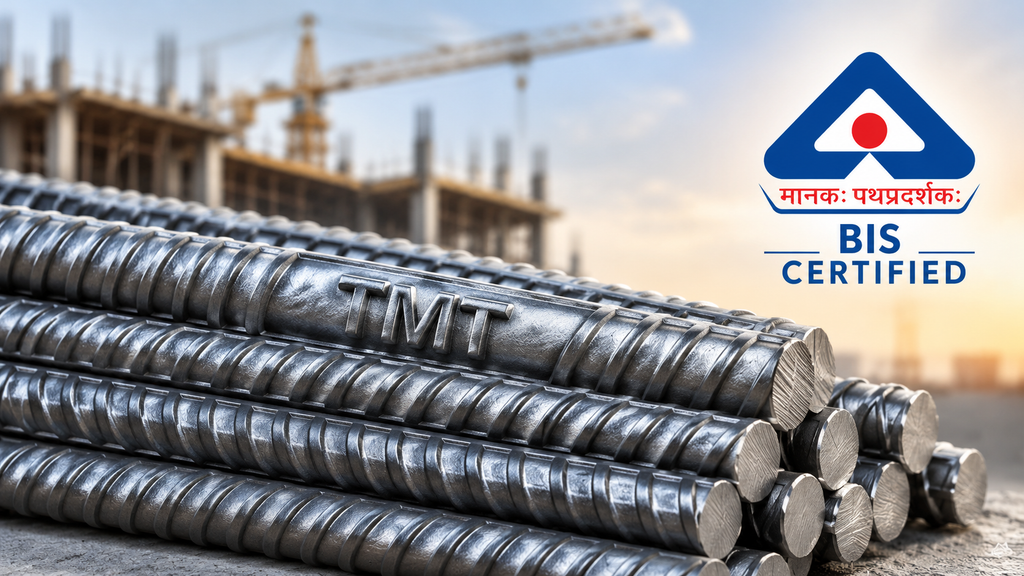
Under the BIS product certification scheme, manufacturers holding the applicable license can use the Standard Mark on conforming products within the license scope.
The certification framework involves prescribed inspection, testing, production controls and record maintenance. It is not simply a declaration made by the manufacturer.
For buyers, BIS certification provides a recognized basis for checking whether the product is covered by the applicable Indian Standard.
You can refer to the official BIS product manual for IS 1786 for details of the certification and inspection framework.
What Do BIS Standards for TMT Bars Check?
IS 1786 specifies various requirements that reinforcement steel must satisfy. These include chemical composition, mechanical properties, dimensions and other product characteristics.
Some important parameters are:
1. Yield Strength
Yield strength indicates the stress at which steel begins to undergo permanent deformation, according to the specified test method. Different TMT grades have different minimum yield or proof-stress requirements.
For example:
- Fe 500: 500 N/mm²
- Fe 500D: 500 N/mm²
- Fe 550: 550 N/mm²
- Fe 550D: 550 N/mm²
The D designation does not mean a higher yield strength. It identifies a category with enhanced specified minimum elongation.
2. Tensile Strength
Tensile strength is the maximum tensile stress reached by a steel specimen during a tensile test. It helps assess how the reinforcement behaves when subjected to pulling forces. The applicable standard specifies tensile-strength requirements and the relationship between tensile strength and yield strength for each grade.
3. Percentage Elongation
Elongation measures the extent to which steel can undergo deformation before fracture under a tensile test. It is an important indicator of ductility. Adequate ductility allows reinforcement to accommodate deformation after yielding, subject to the requirements of the structural design.
4. Bend and Rebend Tests
These tests evaluate how a TMT bar responds to specified bending procedures. They help assess whether the steel meets the prescribed requirements under bending conditions without unacceptable cracking or rupture.
5. Chemical Composition
The chemical composition of steel influences its mechanical properties, weldability and overall performance. IS 1786 specifies limits for elements such as carbon, sulphur and phosphorus, along with relevant carbon-equivalent requirements. These parameters help maintain consistency with the requirements of the specified grade.
Fe 500 vs Fe 500D vs Fe 550D: Understanding the Difference
The grade printed on a TMT bar is not just a product label. It identifies important mechanical requirements that engineers consider when selecting reinforcement.
Here is a simplified comparison of some commonly used grades under IS 1786:
| TMT grade | Minimum yield strength | Minimum elongation |
|---|---|---|
| Fe 500 | 500 N/mm² | 12% |
| Fe 500D | 500 N/mm² | 16% |
| Fe 550 | 550 N/mm² | 10% |
| Fe 550D | 550 N/mm² | 14.5% |
Note: Elongation values are based on the applicable IS 1786 requirements and specified test gauge length. Always check the current standard and the relevant test certificate.
What Does the D Mean in TMT Bars?
The letter D stands for the enhanced ductility category.
For example, Fe 500D and Fe 550D have the same specified minimum yield strength as their corresponding non-D grades, but higher minimum elongation requirements.
This distinction is important in structural applications where deformation capacity is a design consideration.
However, the choice between Fe 500, Fe 500D, Fe 550 and Fe 550D should always be based on the structural engineer’s specifications rather than assuming that a higher grade is automatically suitable for every project.
Why Is Ductility Important for Structural Safety?
Strength is only one part of reinforcement performance. Steel also needs to exhibit the required deformation characteristics.
During severe loading, including earthquake-induced forces, some parts of a properly designed reinforced concrete structure may experience deformation beyond the elastic range.
Ductile reinforcement can contribute to controlled deformation and energy dissipation in the structural system.
This is particularly relevant in earthquake-resistant design, where reinforcement properties, structural detailing and construction quality work together.
It is important to remember that BIS-certified steel alone does not make a building earthquake-proof. The complete structural design, concrete quality, reinforcement arrangement, connections and workmanship also matter.
How Can You Identify BIS-Certified TMT Steel Bars?
Before purchasing reinforcement steel, buyers should verify the certification and supporting documents rather than relying only on a brand name or printed claim.
Here are some practical checks:
1. Look for the BIS Standard Mark
Check the markings on the TMT bars for the applicable Standard Mark and manufacturer identification.
2. Verify the manufacturer’s license
Check that the manufacturer’s BIS license is valid and covers the relevant product and grade. The license scope is important; a manufacturer’s claim alone is not sufficient.
3. Check the test certificate
BIS-certified consignments conforming to IS 1786 are required to be accompanied by a test certificate containing details such as the Standard Mark, cast or lot number, grade, size and corresponding test results.
4. Match the batch details
Compare the cast or lot number on the test certificate with the identification details of the delivered material.
5. Review the mechanical test results
As a final check, compare the yield strength, tensile strength, elongation, and the bend and rebend test results to the specified grade.
6. Inspect the physical condition
Check the bars for visible defects, damage, excessive rusting and other conditions that may require assessment before use.
The BIS product manual provides further information on testing, marking and test certificates. https://www.bis.gov.in/wp-content/uploads/2020/07/PM-IS-1786-JULY-2020-Revised-4.pdf
Frequently Asked Questions About BIS-Certified TMT Steel Bars
1. Why is BIS certification important when buying TMT steel bars?
BIS certification under IS 1786 provides a recognized conformity framework for reinforcement steel. In addition, it covers requirements relating to mechanical properties, chemical composition, dimensions and prescribed testing. Buyers should also check the manufacturer’s license and the test certificate for the supplied consignment.
2. Which BIS standard applies to TMT steel bars in India?
The relevant Indian Standard is IS 1786:2008, titled High Strength Deformed Steel Bars and Wires for Concrete Reinforcement. It specifies requirements for different reinforcement grades, including Fe 415, Fe 500, Fe 550 and Fe 600 and their applicable D categories.
3. What is the difference between Fe 500 and Fe 500D TMT bars?
Both grades have a specified minimum yield strength of 500 N/mm². However, Fe 500D has a higher minimum elongation requirement of 16%, compared with 12% for Fe 500 under the relevant IS 1786 requirements.
4. Are BIS-certified TMT bars suitable for earthquake-resistant construction?
BIS-certified TMT bars that meet the specified grade requirements can be used in structural designs that require conforming reinforcement. However, earthquake-resistant performance depends on the complete structural design, reinforcement detailing, material selection and construction quality. Hence, the structural engineer should select the appropriate grade.
5. What documents should I check before purchasing certified TMT bars?
Check the manufacturer’s valid BIS license and its product scope, the Standard Mark on the bars, and the test certificate for the supplied consignment. The certificate should identify the cast or lot number, grade, size and corresponding test results.
6. Does BIS certification guarantee that TMT bars will never corrode?
No. BIS certification establishes conformity with the applicable product standard; it does not mean that reinforcement is immune to corrosion. Corrosion protection depends on factors such as concrete quality, cover, exposure conditions, workmanship and any specified protective treatment.
7. Where can I buy BIS-certified TMT steel bars in India?
You can contact Banke Tradecom Services Pvt. Ltd., a steel supplier in Raipur, Chhattisgarh, serving customers across India. Furthermore, share your required grade, bar diameter, quantity, and delivery location to check availability, pricing, and documentation.
For more details, visit banketrade.in to discuss your steel requirements.
About us-
At BTS, we stand out as the leading steel supplier all over India. Our decades of experience, in-depth industry knowledge, and customer-first approach make us the preferred choice for all your steel requirements of various brands like SAIL, Tata Steel, JSW, Jindal, JSPL, etc. We proudly deliver PAN India, ensuring timely and reliable supply wherever you are.
📞 Call us now to get a quote!
📍 Location: Raipur (CG)
📞Phone: 07415009930 | 07415009931
✉️Email: sales@banketrade.in | steel@banketrade.in
🌐Website: www.banketrade.in 🌐Blog Site– https://blog.banketrade.in/
Stay Connected with Us on