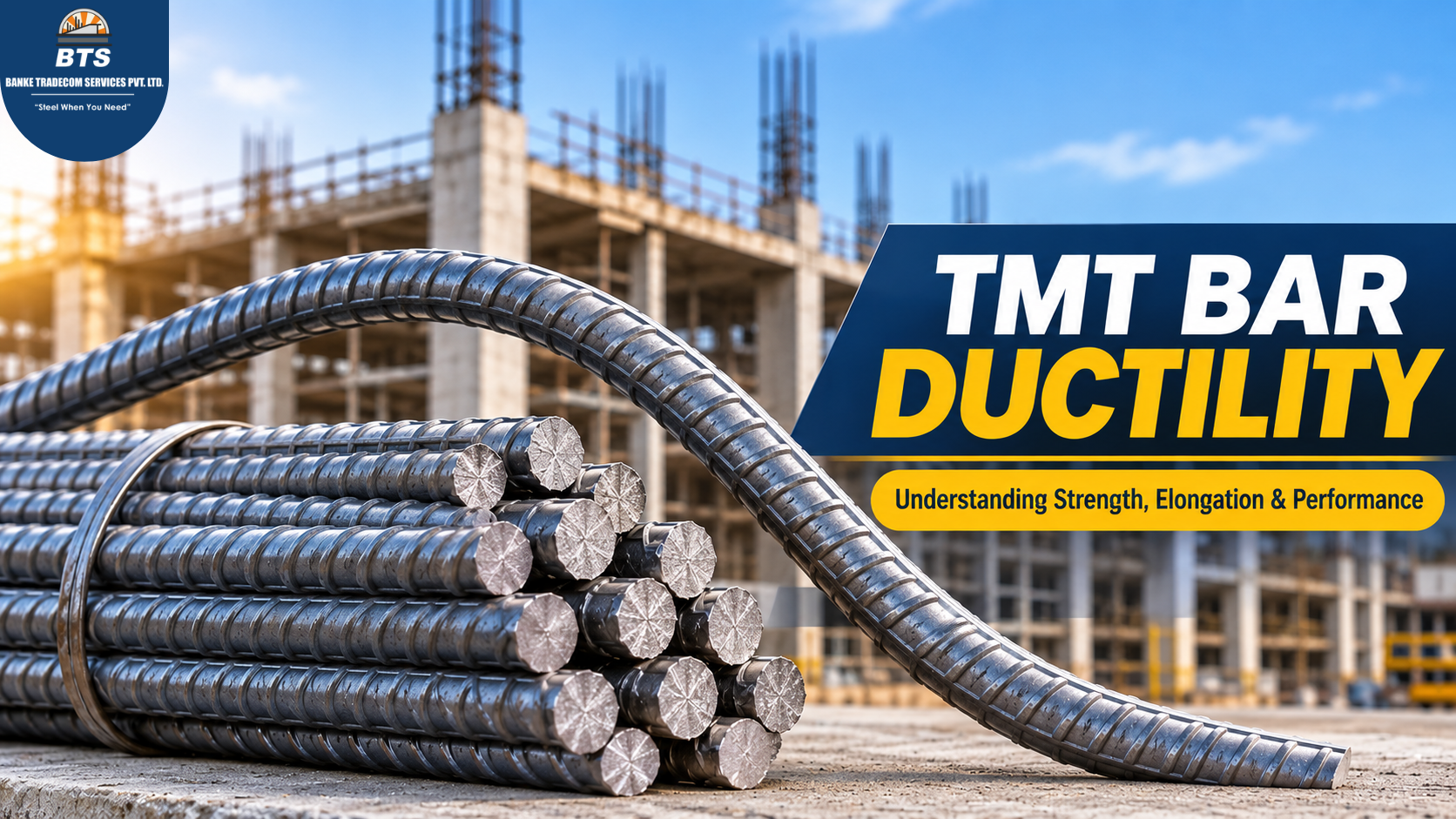
When comparing TMT bar for a construction project, strength is often the first specification buyers check. However, strength alone does not tell the complete story. The steel must also have the ability to deform under stress without fracturing too early.
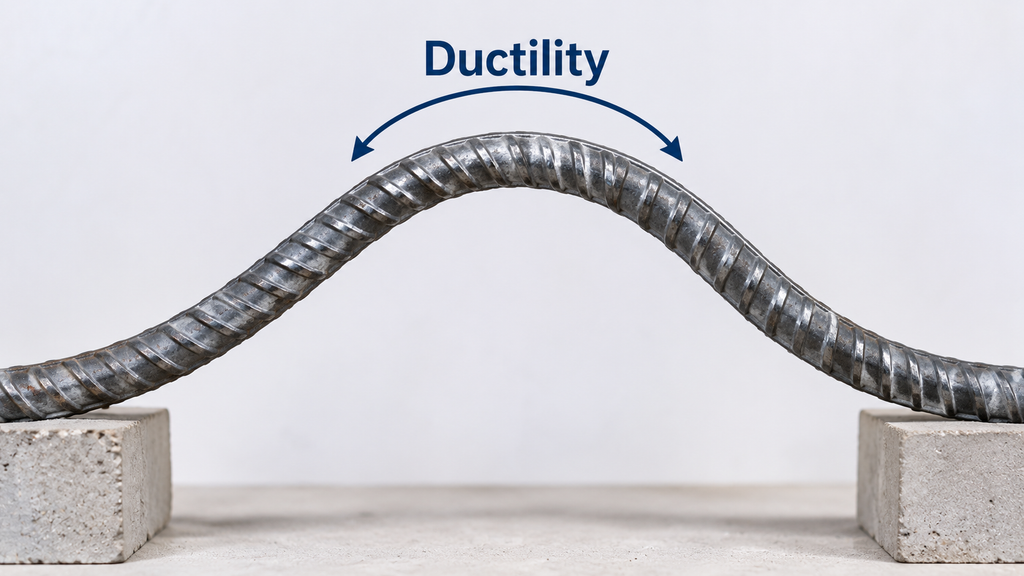
This property is known as ductility in TMT bar. It is particularly important in reinforced concrete structures, where reinforcement must meet specified strength and deformation requirements.
Understanding TMT bar ductility helps contractors, engineers and construction buyers interpret test certificates, compare steel grades and make more informed purchasing decisions.
What Is Ductility in TMT Bar?
Ductility is the ability of a material to undergo permanent deformation before breaking. In reinforcement steel, it describes how much the bar can deform beyond its elastic range before fracture.
When a TMT bar is subjected to a tensile force, it initially stretches elastically. If you remove the force within this range, the bar returns to its original dimensions. Once the steel yields, some deformation becomes permanent.
The ability to sustain further deformation before breaking is what distinguishes ductility from ordinary elastic stretching.
This is why describing a TMT bar as simply “flexible” can be misleading. Ductility is a measurable mechanical property, assessed through laboratory testing rather than by bending a bar by hand.
Strength vs Ductility: What Is the Difference?
Strength and ductility describe different aspects of steel performance.
| Property | Meaning |
|---|---|
| Yield strength | The stress at which the steel begins to undergo permanent deformation, according to the applicable test definition |
| Ultimate tensile strength | The maximum tensile stress reached during a tensile test |
| Ductility | The capacity to undergo deformation before fracture, assessed using specified measurements such as elongation |
A steel bar may meet a specified strength requirement, but its deformation characteristics must also satisfy the requirements for its grade.
For this reason, engineers evaluate strength and ductility together when selecting reinforcement steel. A single strength value cannot establish the complete mechanical performance of a TMT bar.
Why Is TMT Bar Ductility Important in Construction?
TMT bar ductility contributes to the deformation capacity of reinforced concrete structures. Its importance becomes clearer when steel is subjected to loads beyond its initial elastic range.
1. Supports structural deformation capacity
In a properly designed reinforced concrete member, reinforcement may need to yield and deform while continuing to carry load. Adequate ductility helps the steel accommodate this deformation before fracture.
2. Matters in earthquake-resistant design
Earthquake shaking can cause repeated changes in the direction and magnitude of structural forces. In appropriately designed structures, ductile behaviour can help designated regions deform and dissipate energy.
However, ductile reinforcement alone does not make a building earthquake-resistant. Structural design, reinforcement detailing, connections, concrete quality and construction practices all play important roles.
3. Helps engineers assess material suitability
Ductility measurements help engineers determine whether reinforcement meets the mechanical requirements specified for a project. This is especially important when a design calls for particular reinforcement grades or seismic detailing provisions.
4. Supports informed steel purchasing
For contractors and procurement teams, understanding ductility makes it easier to interpret mill test certificates and compare the delivered material with the approved specification.
How Is Ductility Developed During TMT Bar Manufacturing?
TMT stands for thermo-mechanically treated. The process combines hot rolling with controlled cooling and self-tempering to develop the bar’s mechanical properties.
In a conventional TMT process:
- Steel is hot-rolled into the required bar size.
- The hot bar undergoes controlled rapid surface cooling.
- Heat retained in the core tempers the hardened outer region.
- Further cooling develops the final micro structure and mechanical properties.
The resulting structure typically includes a tempered martensitic outer region and a more ductile ferrite-pearlite core. The combination contributes to the characteristic strength and deformation behaviour of TMT reinforcement.
However, the manufacturing method alone does not guarantee a particular ductility result. Steel chemistry, process control and finished-product testing all matter.
How Is TMT Ductility Measured?
Ductility is evaluated through standardized tests. Researchers should compare the results with the correct grade requirements and test method.
1. Percentage elongation after fracture
During a tensile test, a prepared steel specimen is pulled until it fractures. The test operator records the permanent increase in its original gauge length as a percentage.
For example, if a specimen has an original gauge length of 100 mm and measures 116 mm after fracture and reassembly, its elongation is 16%.
This is an illustrative calculation, not a recommended minimum for every TMT grade. The actual test must follow the applicable standard, including its specimen and gauge-length requirements.
2. Total elongation at maximum force (Agt)
Some test reports include total elongation at maximum force, commonly represented as Agt.
This measurement describes the specimen’s extension at a different stage of the tensile test. It is not interchangeable with elongation after fracture.
When you check a test certificate, identify the exact parameter the report shows before you compare percentages from different products.
3. Bend and rebend tests
Bend and rebend tests assess how a specimen responds to prescribed bending procedures and whether unacceptable cracking or rupture occurs under the test conditions.
These tests complement tensile-test results. A laboratory bend test cannot prove that a bar can be bent and straightened repeatedly on a construction site. Fabrication must follow the approved reinforcement details and applicable procedures.
What Does the “D” Mean in Fe 500D and Fe 550D TMT Bars?
The letter D in grades such as Fe 500D and Fe 550D identifies a grade category with enhanced specified ductility requirements compared with the corresponding grade without the D designation.
For example, Fe 550 and Fe 550D share a specified minimum yield or proof stress of 550 N/mm², but the D category has enhanced minimum elongation requirements under the applicable specification.
This is why buyers should check the complete grade designation rather than treating Fe 500 and Fe 500D, or Fe 550 and Fe 550D, as interchangeable.
The required values depend on the exact grade and applicable version of the standard. Always compare the test results with the relevant grade requirements rather than assuming that every D-grade bar has the same elongation value.
What Should Buyers Check in a TMT Bar Test Certificate?
Before accepting reinforcement for a construction project, request a mill test certificate that corresponds to the actual supplied material.
Review the following details with the project engineer or quality-control team:
- Grade and bar size: Confirm that the delivered steel matches the approved specification.
- Cast or heat number: Check that the material identification corresponds to the delivery and test documentation.
- Yield strength: Verify the reported value against the specified grade.
- Ultimate tensile strength: Check the tensile strength result.
- Elongation: Identify the elongation parameter reported and compare it to the applicable requirement.
- TS/YS ratio: Review the tensile-strength-to-yield-strength ratio where required by the specification or project design.
- Bend and rebend results: Check the relevant test outcomes where applicable.
- Certification and traceability: Verify the applicable BIS certification and supporting documents for the supplied material.
A certificate for a different batch does not prove the properties of the steel delivered to your site. Traceability is an important part of quality control.
BIS lists IS 1786:2008 for High Strength Deformed Steel Bars and Wires for Concrete Reinforcement, with amendments noted in 2023. Confirm the latest applicable requirements before approving material.
Frequently Asked Questions About TMT Bar Ductility
What is ductility in TMT bars?
Ductility is the ability of TMT reinforcement steel to undergo permanent deformation before breaking. We assess ductility using specified mechanical tests, including elongation measurements.
Why is TMT bar ductility important?
Adequate ductility helps reinforcement accommodate deformation after yielding. This property is relevant to structural performance, particularly where a design relies on controlled deformation under severe loading.
Does higher ductility mean lower strength?
Not necessarily. Strength and ductility are separate mechanical properties. A TMT grade must satisfy the relevant requirements for both properties rather than being judged by one value alone.
Which is more ductile: Fe 500 or Fe 500D?
Fe 500D has enhanced specified minimum elongation requirements compared with Fe 500 under the applicable IS 1786 grade requirements. Check the current standard and the supplied material’s test certificate for the exact values.
How can I check TMT bar ductility?
Review the mill test certificate for the applicable elongation measurements, tensile-strength results and other required mechanical tests. Bend and rebend tests provide additional information. Visual inspection or hand bending cannot establish a verified elongation percentage.
Does ductility make a building earthquake-proof?
No. Ductile reinforcement can contribute to a structure’s ability to accommodate deformation, but earthquake performance also depends on structural design, detailing, materials, connections and construction quality.
What standard applies to TMT bar ductility in India?
IS 1786:2008 covers high-strength deformed steel bars and wires for concrete reinforcement. Buyers should verify the applicable amendments and grade requirements before accepting a consignment.
Where can I buy quality TMT bars in India?
You can buy TMT bars from Banke Tradecom Services Pvt. Ltd., a steel supplier based in Raipur, Chhattisgarh, serving steel requirements across India. The company deals in TMT bars and various other steel products for construction and industrial requirements. Contact on 7415009930.
About us-
At BTS, we stand out as the leading steel supplier all over India. Our decades of experience, in-depth industry knowledge, and customer-first approach make us the preferred choice for all your steel requirements of various brands like SAIL, Tata Steel, JSW, Jindal, JSPL, etc. We proudly deliver PAN India, ensuring timely and reliable supply wherever you are.
📞 Call us now to get a quote!
📍 Location: Raipur (CG)
📞Phone: 07415009930 | 07415009931
✉️Email: sales@banketrade.in | steel@banketrade.in
🌐Website: www.banketrade.in 🌐Blog Site– https://blog.banketrade.in/
Stay Connected with Us on