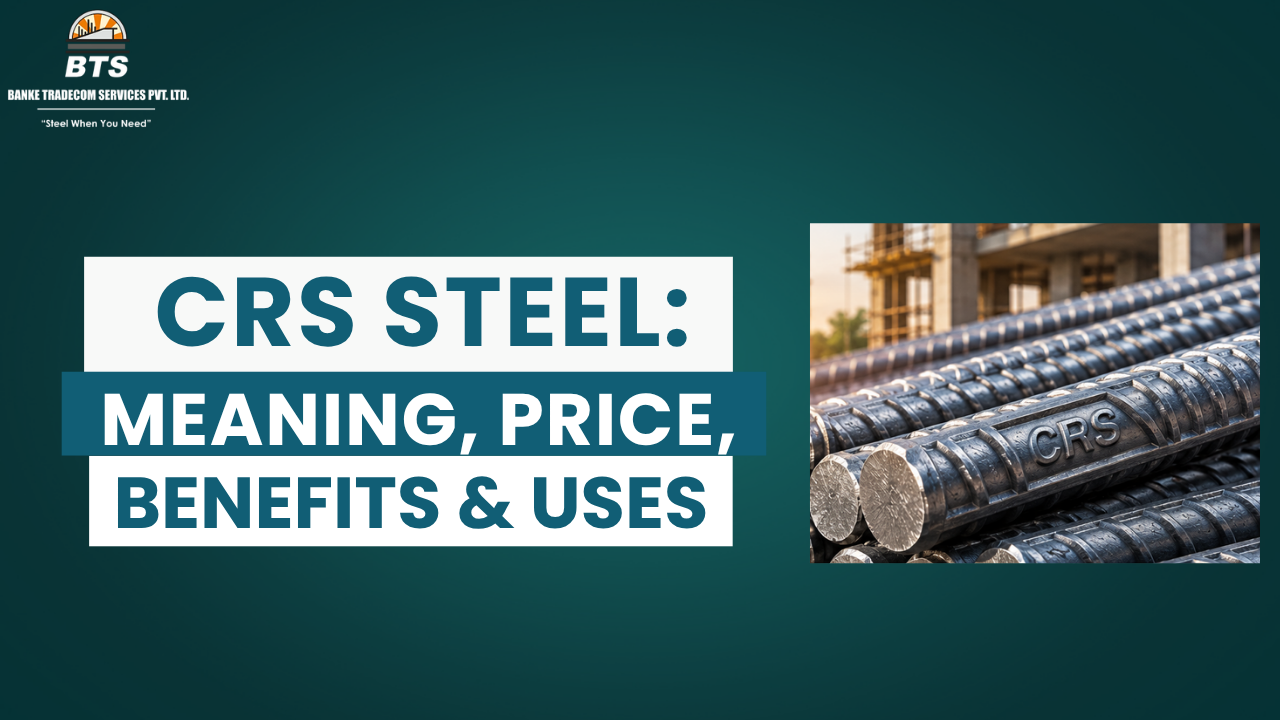
Corrosion is one of the major challenges in reinforced concrete construction. Moisture, coastal air, chlorides and aggressive environmental conditions can cause steel reinforcement to rust over time, potentially increasing maintenance requirements and affecting structural durability. This is where CRS Steel becomes an important consideration.
CRS TMT bars are designed to offer enhanced corrosion resistance while providing the strength and ductility required for reinforced concrete structures. They can be particularly useful in projects where conventional reinforcement may face greater exposure to corrosive conditions.
But what is CRS steel, how does it differ from regular TMT bars, and when is it worth considering?
In this guide, we cover the CRS steel full form, CRS steel meaning, grades, properties, applications, price factors and important points to check before buying.
What Is the CRS Steel Full Form?
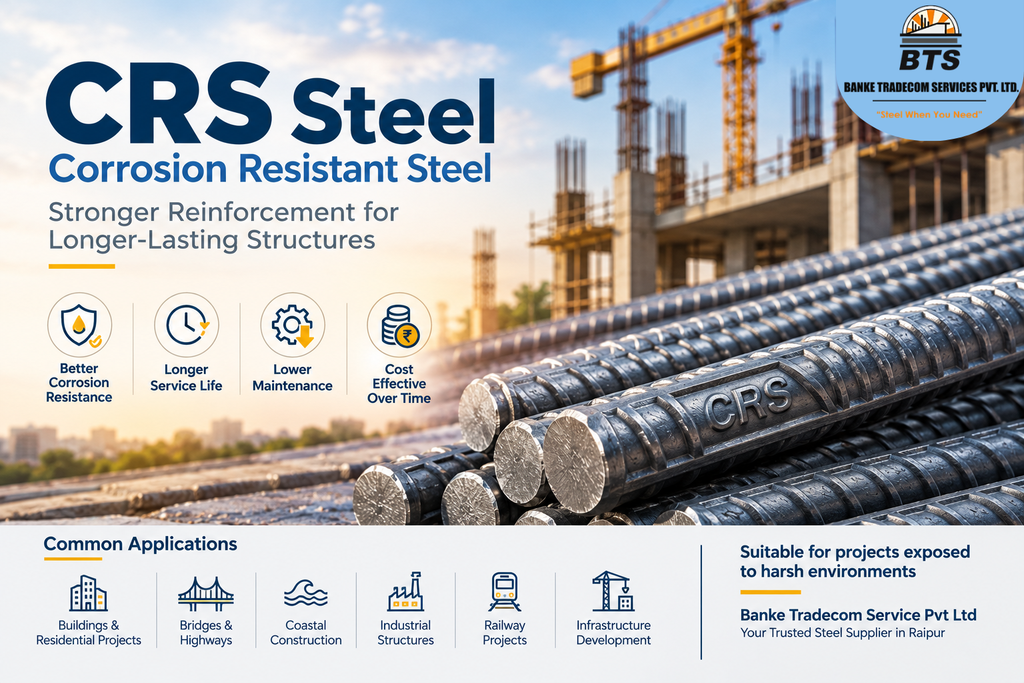
The CRS steel full form is Corrosion Resistant Steel.
In construction, the term commonly refers to TMT reinforcement bars. Moreover, they contain alloying elements that resist corrosion better than conventional reinforcement steel.
CRS TMT bars may contain elements such as copper, chromium and phosphorus in controlled proportions. However, the exact composition depends on the manufacturer and product specification.
These elements help improve corrosion resistance while the steel retains the mechanical properties required for reinforcement.
CRS Steel Meaning: How Does It Work?
The meaning of CRS steel becomes easier to understand when we consider how reinforcement corrodes.
Generally, steel reinforcement inside concrete is protected by the concrete’s alkaline environment. However, prolonged exposure to moisture, chlorides or other aggressive conditions can compromise this protection and initiate corrosion.
As rust develops, it can expand and place pressure on the surrounding concrete. Over time, this may contribute to cracking, concrete damage and increased maintenance requirements.
Additionally, CRS Steel reinforcement slows corrosion under suitable exposure conditions through its controlled alloy composition.
However, CRS steel is not rust-proof. Its performance also depends on concrete quality, adequate cover, construction practices, environmental exposure and the specified steel grade.
How Is CRS Steel Manufactured?
CRS TMT bars are produced through steel making and rolling processes that control both the chemical composition and mechanical properties of the finished product.
Additionally, the general manufacturing process involves:
1. Steel making
Steel is produced using the manufacturer’s selected raw materials and production process. The chemical composition is controlled to achieve the required properties.
2. Alloying
Selected elements, which may include copper and chromium, are added in controlled proportions to improve corrosion resistance.
The precise alloy composition varies by manufacturer and product grade.
3. Rolling
The steel is processed into reinforcement bars of the required diameters.
4. Thermo-Mechanical Treatment
The bars undergo controlled heating, quenching and self-tempering processes, depending on the production technology. These processes help achieve the required combination of strength and ductility.
5. Testing and Quality Control
The finished bars are checked against the applicable product requirements. Depending on the specification, testing may include tensile properties, elongation, bend performance, dimensions and chemical composition.
For Indian TMT reinforcement bars, buyers should verify compliance with the applicable IS 1786 requirements and the specific grade ordered.
CRS Steel Grades: Which Grade Should You Choose?
CRS reinforcement is available in different strength and ductility grades, depending on the manufacturer and product range.
Common product designations include:
| CRS TMT Grade | General Description |
|---|---|
| Fe 500D CRS | Corrosion-resistant reinforcement with the specified Fe 500D strength and ductility requirements |
| Fe 550D CRS | Corrosion-resistant reinforcement with the specified Fe 550D strength and ductility requirements |
Furthermore, actual availability and mechanical properties should be confirmed from the manufacturer’s technical documentation.
What Does Fe 500D CRS Mean?
This designation combines the strength grade, ductility classification and corrosion-resistant variant.
- Fe 500: Identifies the nominal yield-strength grade.
- D: Indicates the ductility classification associated with the grade.
- CRS: Identifies the corrosion-resistant variant.
What Does Fe 550D CRS Mean?
Fe 550D CRS is a corrosion-resistant TMT reinforcement product in the Fe 550D category.
It is designed to combine the specified strength and ductility properties with enhanced corrosion resistance.
The correct grade should be selected according to the structural design, project specification and applicable standards—not simply because a higher grade sounds stronger.
What Does “D Quality” Mean in CRS Steel?
The letter D in grades such as Fe 500D and Fe 550D refers to the ductility classification.
Ductility describes the ability of steel to deform before failure. This property is important in reinforced concrete construction, particularly where reinforcement must accommodate deformation under demanding loading conditions.
However, the D designation does not itself mean that the steel is corrosion-resistant. The CRS designation identifies the corrosion-resistant variant.
This distinction matters when comparing different TMT products.
Key Properties of CRS Steel
The performance of CRS reinforcement depends on the exact grade, chemical composition and manufacturing quality.
Important properties include:
1. Enhanced Corrosion Resistance
Controlled alloying helps improve resistance to corrosion compared with conventional reinforcement under suitable exposure conditions.
2. Strength
CRS TMT bars are available in specified strength grades such as Fe 500D and Fe 550D, subject to the manufacturer’s product range and applicable standards.
3. Ductility
Ductility allows the reinforcement to deform according to its specified mechanical requirements. The exact performance should be checked against the grade’s technical data.
4. Bond With Concrete
The ribbed surface of TMT reinforcement helps provide mechanical interlock with concrete. Bond performance depends on bar geometry, concrete quality and correct installation.
5. Long-Term Durability
When used in an appropriate application alongside good concrete design and construction practices, CRS reinforcement can help manage corrosion-related durability risks.
CRS Steel vs Regular TMT Bars
The main difference is the emphasis on corrosion resistance.
| Feature | CRS TMT Bars | Conventional TMT Bars |
|---|---|---|
| Primary purpose | Reinforcement with enhanced corrosion resistance | Structural reinforcement |
| Alloy composition | Controlled corrosion-resistant alloying elements | Depends on the specified grade |
| Strength | Depends on the selected grade | Depends on the selected grade |
| Corrosion performance | Designed for improved resistance | Depends on composition and exposure |
| Suitable applications | Projects with elevated corrosion concerns | General reinforced concrete construction |
| Initial purchase cost | May be higher | Varies by grade and brand |
Both types must meet the requirements of the structural design. CRS bars should not be treated as a substitute for proper concrete cover, suitable concrete quality or good construction practices.
Where Is CRS Steel Used?
The main advantage of CRS reinforcement is its suitability for projects where corrosion presents a significant durability concern.
1. Coastal Construction
Structures near the sea may be exposed to salt-laden air and chlorides. CRS reinforcement may be considered where the project specification identifies a need for enhanced corrosion resistance.
2. Bridges and Highways
Bridges, flyovers and highway structures can face moisture, pollutants and de-icing or other chloride exposure depending on their location.
CRS reinforcement may be suitable for specified components where corrosion protection is a priority.
3. Industrial Structures
Industrial facilities may expose reinforced concrete to moisture, chemicals or other aggressive conditions. Material selection should be based on the actual exposure and engineering requirements.
4. Foundations and Below-Ground Structures
Foundations and underground components may experience moisture and aggressive soil or groundwater conditions. The need for CRS reinforcement should be evaluated against site conditions and the structural specification.
5. Infrastructure Projects
Large infrastructure developments often have long service-life expectations. CRS reinforcement may be specified for particular elements where corrosion-related durability is a concern.
Not every infrastructure project requires CRS steel. The final selection depends on the design, exposure conditions and project specifications.
CRS Steel Price: What Affects the Cost?
The CRS steel price varies with market conditions and the specifications of the reinforcement bars.
There is no single fixed rate applicable to every CRS product.
Key factors affecting the price include:
- Grade: Fe 500D CRS and Fe 550D CRS may have different prices.
- Diameter: Rates and weight calculations depend on the bar size and supplier’s pricing basis.
- Brand: Manufacturer, production quality and product availability can affect quotations.
- Raw material costs: Changes in steel making inputs and alloying costs can influence prices.
- Order quantity: Bulk requirements may be quoted differently from smaller orders.
- Location and freight: Transportation and unloading can affect the delivered cost.
- Taxes and commercial terms: GST and other applicable charges should be clarified in the quotation.
How to Compare CRS Steel Prices
When comparing quotations, make sure you are comparing the same grade, diameter, brand specification and quantity.
Also confirm whether the quoted rate includes GST, transportation and unloading.
A lower initial price is not always the most suitable choice if the product does not meet the project’s technical requirements.
For the most accurate rate, request a current quotation based on your required grade, bar sizes, quantity and delivery location.
Frequently Asked Questions About CRS Steel
1. What is the full form of CRS steel?
CRS stands for Corrosion Resistant Steel. In construction, it commonly refers to TMT reinforcement bars designed to provide enhanced resistance to corrosion.
2. What is CRS steel used for?
CRS steel is used in reinforced concrete projects where corrosion is a concern, including selected coastal structures, bridges, industrial facilities, foundations and infrastructure projects.
3. What is the difference between CRS steel and normal TMT bars?
CRS TMT bars are designed with controlled alloying to improve corrosion resistance. Conventional TMT bars provide structural reinforcement, but their corrosion performance depends on their composition, grade and exposure conditions.
4. Which CRS steel grade is best?
There is no single best grade for every project. Fe 500D CRS and Fe 550D CRS are examples of available product designations. The appropriate grade depends on structural calculations, project specifications and required mechanical properties.
5. What is the CRS steel price per kg?
The price varies with grade, diameter, brand, market conditions, quantity, GST and transportation. Request a current quotation based on your specific requirements rather than relying on an outdated rate.
6. Is CRS steel rust-proof?
No. CRS steel is designed to improve corrosion resistance, but it can still corrode under unsuitable or aggressive conditions. Concrete cover, concrete quality and correct construction practices remain important.
7. What does the D mean in Fe 550D CRS?
The D indicates the ductility classification of the Fe 550D grade. CRS identifies the corrosion-resistant variant.
8. Is CRS steel suitable for coastal construction?
It may be suitable where the structural design and project specification call for enhanced corrosion resistance. The exact grade and protection strategy should be determined by the project’s engineering requirements.
9. Which standard applies to CRS TMT bars in India?
IS 1786 is an important Indian standard for high-strength deformed steel bars and wires used for concrete reinforcement. Confirm the product’s applicable requirements and certification before purchasing.
10. Where can I buy CRS steel?
You can contact a steel supplier in Raipur, such as Banke Tradecom Service Pvt Ltd, to discuss bulk steel requirements for pan India delivery. Share the required grade, bar sizes, tonnage and delivery location to obtain a suitable quotation.
About us-
At BTS, we stand out as the leading steel supplier all over India. Our decades of experience, in-depth industry knowledge, and customer-first approach make us the preferred choice for all your steel requirements of various brands like SAIL, Tata Steel, JSW, Jindal, JSPL, etc. We proudly deliver PAN India, ensuring timely and reliable supply wherever you are.
📞 Call us now to get a quote!
📍 Location: Raipur (CG)
📞Phone: 07712292080 | 07415009930 | 07415009931
✉️Email: sales@banketrade.in | steel@banketrade.in
🌐Website: www.banketrade.in 🌐Blog Site– https://blog.banketrade.in/
Stay Connected with Us on