
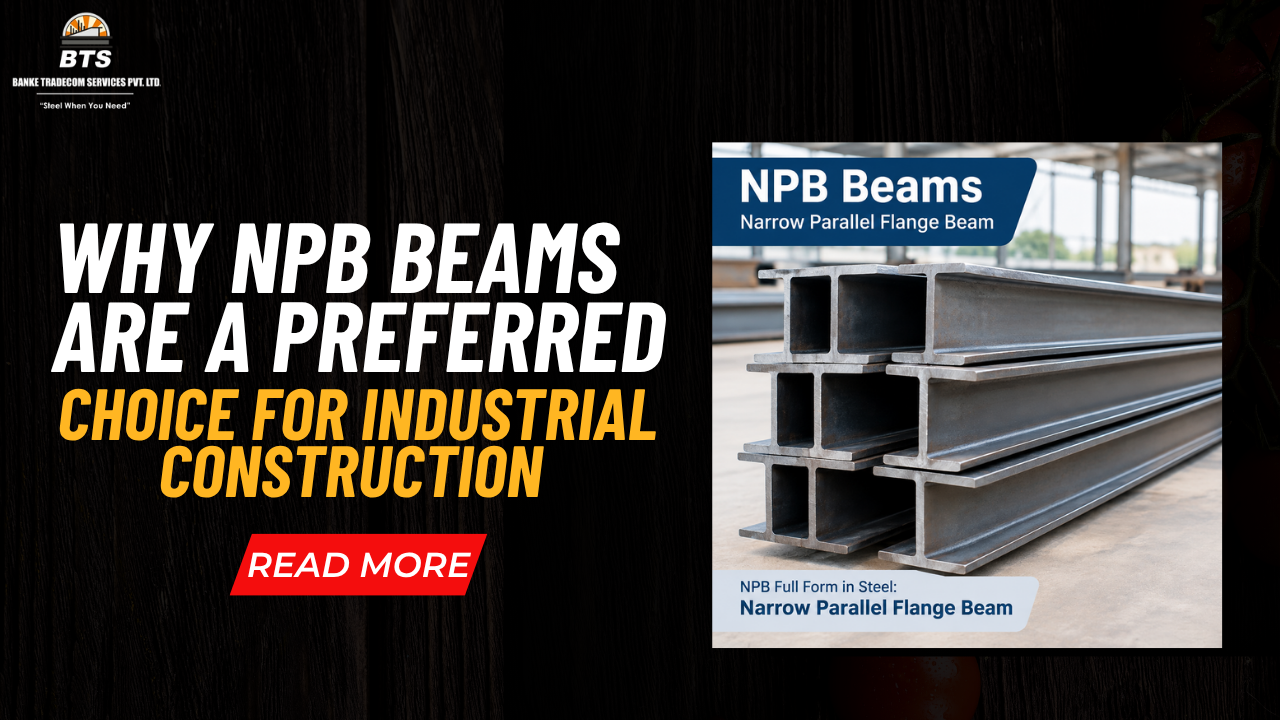
Among the different structural steel sections used in construction, NPB beams are widely considered for applications where strength, efficient load transfer, and practical fabrication are important.
For contractors, fabricators, engineers, and procurement teams, understanding the advantages and applications of an NPB beam can help in making better structural steel procurement decisions.
Understanding the Geometry of an NPB Beam
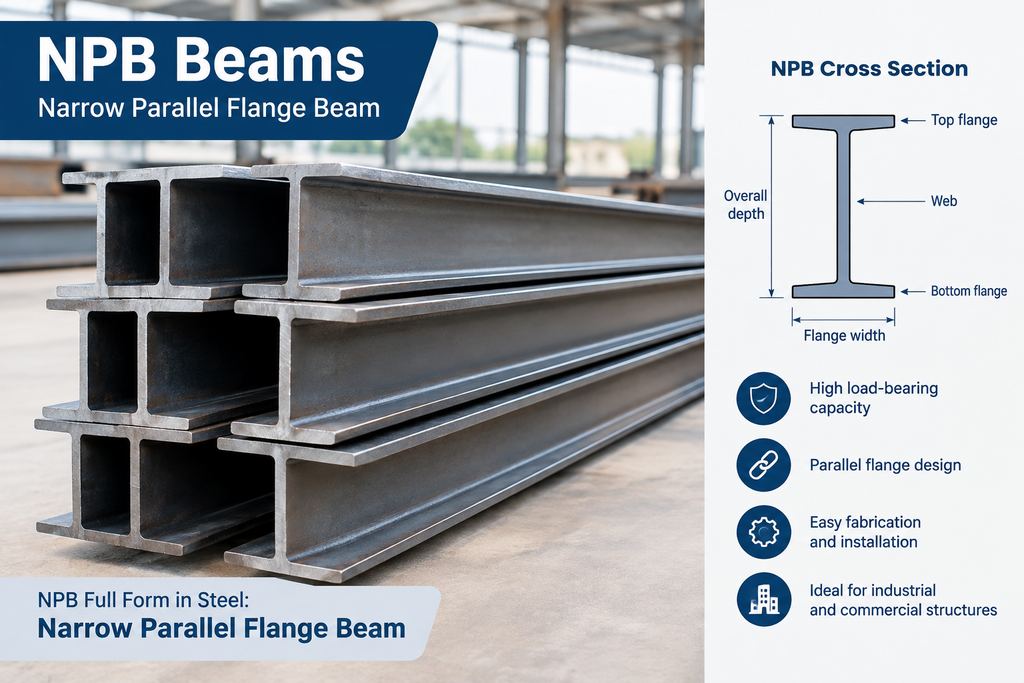
One of the key characteristics of an NPB beam is its parallel flange profile.
The parallel arrangement of the flanges provides a consistent section geometry and can simplify several fabrication and connection activities.
Key characteristics include:
- Parallel flange configuration
- Efficient structural geometry
- Good bending resistance when appropriately selected
- Compatibility with bolted and welded connections
- Availability in different sizes and section weights
- Suitability for fabricated steel structures
Because of these characteristics, NPB beams can be incorporated into different modern steel framing systems where the selected section meets the required structural design criteria.
Why Are NPB Beams Widely Used in Industrial Construction?
Industrial buildings often need to accommodate heavy machinery, storage systems, cranes, mezzanine floors, production equipment, and other operational loads.
An appropriately selected NPB beam can provide a combination of structural strength, stiffness, and fabrication convenience for such applications.
1. High Load-Carrying Capacity
One of the major considerations when selecting a structural beam is its ability to safely transfer the loads imposed on the structure.
NPB beams can be used in applications requiring substantial structural capacity when the appropriate section is selected through engineering calculations.
Common applications include:
- Industrial warehouses
- Manufacturing plants
- Heavy-duty production facilities
- Multi-level steel structures
- Material-handling systems
- Industrial platforms
Beam selection should always be based on the actual loading and structural requirements of the project rather than on beam type alone.
2. Efficient Strength-to-Weight Performance
Modern construction focuses not only on structural strength but also on efficient steel utilization.
The section properties of NPB beams allow engineers to evaluate different beam sizes and weights to achieve the required structural performance without automatically selecting an oversize section.
This can contribute to:
- Better material utilization
- Reduced unnecessary dead load
- Efficient structural framing
- Better foundation planning
- Improved project economics
The final section should be selected by a qualified structural engineer based on design requirements.
3. Suitable for Longer Spans
Industrial facilities often require open floor areas with fewer internal columns.
Depending on the span, loading, and design requirements, NPB beams can be considered for applications where adequate bending resistance and stiffness are required.
Fewer internal columns can provide:
- More flexible warehouse layouts
- Better movement of equipment
- Larger storage areas
- Improved production-floor utilization
- Greater flexibility for future modifications
This makes appropriately selected NPB sections useful in several industrial and commercial structural applications.
4. Convenient Fabrication and Installation
Fabrication efficiency is another important factor in structural steel construction.
The standardized geometry of NPB sections can support fabrication activities such as:
- Cutting
- Drilling
- Welding
- Bolting
- Assembly
- Connection detailing
Better coordination between structural designers, fabricators, and erection teams can help reduce unnecessary site modifications and improve construction efficiency.
5. Compatibility with PEB Structures
Pre-Engineered Buildings (PEBs) are widely used for industrial and commercial applications because they can offer efficient construction and flexible building layouts.
Depending on the structural design, NPB beams can be incorporated into:
- Primary framing systems
- Secondary steel systems
- Mezzanine structures
- Crane-support frameworks
- Roof and wall framing assemblies
The suitability of an NPB beam for a PEB depends on the structural design, loading conditions, connection requirements, and section properties.
How NPB Beam Improve Structural Performance
Selecting the right structural steel section affects more than the initial strength of a building. It can also influence fabrication, erection, material utilization, maintenance, and future expansion.
Efficient Load Transfer
A properly designed structural system transfers loads from roofs and floors through beams and columns and ultimately to the foundations.
The parallel-flange geometry and section properties of NPB beams allow engineers to evaluate them for efficient load transfer in suitable structural applications.
Structural Stiffness and Deflection Control
Excessive beam deflection can affect the serviceability and performance of a structure.
When correctly designed and specified, an NPB beam can provide the required stiffness for applications such as:
- Precision manufacturing areas
- Automated storage systems
- Material-handling structures
- Mezzanine floors
- Industrial platforms
The actual deflection performance depends on the selected section, span, loading, support conditions, and structural design.
Beam-to-Column Connections
Connections are an important part of any structural steel system.
The geometry of NPB sections can facilitate the detailing of bolted and welded connections. Properly designed connections can contribute to:
- Better structural continuity
- Faster erection
- Improved fabrication accuracy
- Better quality control
- Reduced site modifications
Important Factors to Check Before Buying NPB Beams
Before purchasing an NPB beam, buyers should consider more than the quoted price.
1. Section Size
Confirm the required beam depth, flange dimensions, thickness, and mass per meter according to the approved structural design.
2. Material Grade
Verify that the supplied steel grade matches the project specification.
3. Applicable Standards
Check the relevant Indian Standard and project-specific requirements before procurement.
4. Mill Test Certificate
For critical structural projects, buyers should request appropriate material documentation, including Mill Test Certificates (MTC), wherever required.
5. Dimensional Accuracy
Verify that the supplied NPB sections conform to the specified dimensions and applicable tolerances.
6. Material Traceability
Maintaining proper documentation and traceability can make quality control, inspection, maintenance, and future structural modifications easier.
7. Reliable Supply
For large projects, consistent availability and timely delivery can be as important as the material price.
Common Mistakes When Selecting NPB Beams
Even quality structural steel cannot compensate for poor engineering or procurement decisions.
Choosing Only on Price
The cheapest beam is not necessarily the most economical option.
Consider:
- Material cost
- Fabrication cost
- Transportation
- Erection
- Maintenance
- Future modification requirements
Ignoring Structural Calculations
Beam selection should be based on structural analysis rather than assumptions or previous projects.
Each structure has different:
- Loading conditions
- Span requirements
- Support conditions
- Deflection criteria
- Environmental conditions
Selecting the Wrong Beam Size
Oversize sections can increase material costs, while undersized sections may fail to meet structural requirements.
The correct NPB size should therefore be determined through engineering calculations.
Ignoring Corrosion Protection
Industrial environments can expose structural steel to moisture, chemicals, dust, and other corrosive conditions.
The appropriate corrosion-protection system should be considered according to the project’s environment.
Purchasing Without Documentation
For structural projects, buyers should verify relevant documentation and quality requirements before accepting material.
Depending on the project, this may include:
- Mill Test Certificates
- Material traceability
- Applicable standards
- Dimensional compliance
- Inspection documentation
Frequently Asked Questions About NPB Beams
1. What is the NPB full form in steel?
The NPB full form in steel is Narrow Parallel Flange Beam. NPB sections are structural steel beams with substantially parallel inside flange surfaces.
2. What is an NPB beam used for?
An NPB beam can be used in warehouses, industrial buildings, manufacturing plants, PEB structures, mezzanine floors, platforms, and other steel structures where its section properties meet the design requirements.
3. Are NPB beams suitable for industrial construction?
Yes. NPB beams can be considered for industrial construction applications because their structural geometry and available section range make them suitable for various engineered steel structures.
4. What is the difference between NPB and ISMB beams?
NPB and ISMB are different structural steel beam sections with different geometries and section properties. The appropriate choice depends on the project’s span, loading, stiffness, connection requirements, and structural calculations.
5. Which standard applies to NPB beams?
NPB sections are classified under Indian Standards for hot-rolled parallel-flange steel sections. Buyers should verify the applicable standard specified for their project and procurement requirement.
6. What should I check before buying an NPB beam?
Before purchasing, check the required section size, steel grade, applicable standard, dimensional requirements, material certification, quantity, and delivery requirements.
About us-
At BTS, we stand out as the leading steel supplier all over India. Our decades of experience, in-depth industry knowledge, and customer-first approach make us the preferred choice for all your steel requirements of various brands like SAIL, Tata Steel, JSW, Jindal, JSPL, etc. We proudly deliver PAN India, ensuring timely and reliable supply wherever you are.
📞 Call us now to get a quote!
📍 Location: Raipur (CG)
📞Phone: 07415009930 | 07415009931
✉️Email: sales@banketrade.in | steel@banketrade.in
🌐Website: www.banketrade.in 🌐Blog Site– https://blog.banketrade.in/
Stay Connected with Us on