
In this blog, we’ll cover why Steel Weight Chart are essential, how to use them, and provide insights into different steel product weights. Whether you’re working with TMT bars, beams, or sheets, this guide will help you understand steel weights for better project planning and accuracy.
Understanding steel weights helps optimize material usage, cost, and transportation, ultimately ensuring project efficiency. At Banke Tradecom Services Pvt Ltd (BTS), a trusted steel supplier in Raipur, we aim to provide the resources you need, from high-quality steel products to accurate steel weight charts.
What is a Steel Weight Chart?
A steel weight chart is a tool that helps determine the weight of different steel materials based on dimensions and grade. It’s often used by engineers, architects, and suppliers to calculate the weight of various steel sections, ensuring accurate ordering, cost estimation, and load management.
The steel weight chart provided here includes the most common steel types—TMT bars, mild steel sheets, angles, channels, and more—along with their weight per unit length or area. This makes it easier to find the exact weight and calculate requirements without needing to individually weigh each component.
Types of Steel Products in the Weight Chart
- TMT Bars (Thermo-Mechanically Treated Bars)
Commonly used in construction, TMT bars offer high strength and durability. Our chart includes TMT bars in various diameters to help you calculate the total weight for your reinforcement needs. - Mild Steel Sheets and Plates
Steel sheets are used across industries, from automotive to construction. Sheets and plates come in different thicknesses, and knowing their weight helps in cost estimation and easy material handling. - Steel Angles and Channels
These L-shaped and U-shaped steel products are critical in structural framing and construction. Our weight chart covers different sizes for accurate calculations, essential for load-bearing structures. - Steel Pipes
Steel pipes are widely used in plumbing, HVAC, and industrial projects. Different diameters and wall thicknesses are included in the chart for precise weight calculation based on pipe dimensions. - Flat Bars and Round Bars
Used in manufacturing, construction, and fabrication, flat and round bars come in various sizes and grades. Our weight chart provides accurate weights for both types, aiding in estimation and purchasing decisions.
Using the Steel Weight Chart
Each row in the steel weight chart represents a specific steel product’s weight based on its dimensions. Simply find the product type (e.g., TMT bar, angle, sheet) and locate the relevant dimension or diameter to see its weight. Multiply the weight per unit length (or area) by the total length or area you require to determine the final weight for your project.
Steel Weight Chart: Example Calculations
To give you an idea of how to use the chart, here are two example calculations:
- TMT Bar Calculation
Suppose you’re using a 12mm diameter TMT bar and need 100 meters. If the weight per meter is 0.888 kg, the total weight would be:
100meters×0.888kg/meter=88.8kg
- Mild Steel Sheet Calculation
For a 5mm thick MS sheet of 1 square meter, if the weight per square meter is 39.25 kg, then for 10 sheets, the total weight would be:
10sheets×39.25kg/sq meter=392.5kg
Weight Chart
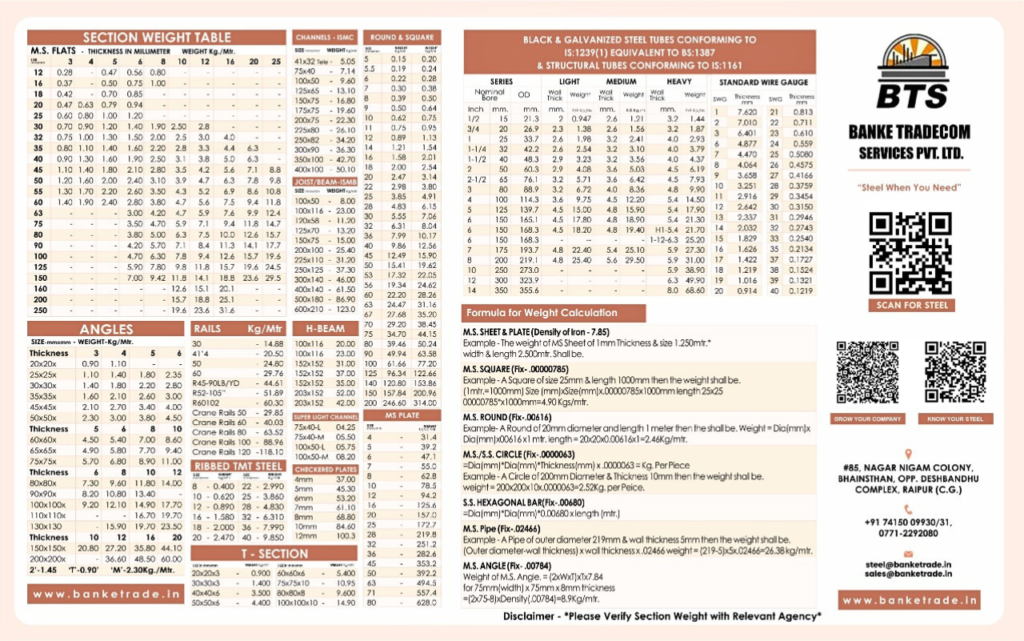
For pdf of weight chart, message on whatsapp- 07712292080
About us-
At BTS, we stand out as the leading steel distributor all over India. Our decades of experience, in-depth industry knowledge, and customer-first approach make us the preferred choice for all your steel requirements of various brands like SAIL, Tata Steel, JSW, Jindal, JSPL, etc. We proudly deliver PAN India, ensuring timely and reliable supply wherever you are.
📞 Call us now to get a quote!
📍 Location: Raipur (CG)
📞Phone: 07712292080 | 07415009930 | 07415009931
✉️Email: sales@banketrade.in | steel@banketrade.in
🌐Website: www.banketrade.in 🌐Blog Site– https://blog.banketrade.in/
Stay Connected with Us on
Frequently Asked Questions
1. How accurate is the steel weight chart?
Our steel weight chart uses standard weights and dimensions; however, actual weights may vary slightly based on steel grade and production specifications. Always consult with a supplier for critical weight requirements.
2. What units are used in the steel weight chart?
The chart generally lists weights in kilograms per meter or per square meter for ease of calculation.
3. Can I get a customized weight chart for specific steel products?
Yes, at BTS, we can provide tailored weight charts based on specific product dimensions, steel grade, and project requirements.
4. Why is the weight of steel important in construction?
Steel weight affects structural load, material handling, and cost calculations, making it a crucial factor in planning and project execution.